

Landing a job offer is exciting until you realise the number on your offer letter isn’t what hits your bank account. That’s where a take-home pay-to-salary calculator becomes essential.
Many job seekers targeting the UK job market make a critical mistake: they focus on gross salary instead of what they’ll actually earn monthly. The difference can be significant, and misunderstanding it can lead to poor financial planning, unrealistic expectations, or even accepting the wrong job.
What Is a Take-Home Pay Calculator?

A take-home pay calculator is a tool that estimates your net salary, the amount you receive after all deductions.
These deductions typically include:
- Income tax
- National Insurance contributions
- Pension payments
- Student loan repayments (if applicable)
We’ve seen candidates accept roles in the UK believing they would earn comfortably, only to struggle because they didn’t account for deductions. This is especially common among international applicants unfamiliar with the UK tax system.
How Salary Is Converted to Take-Home Pay in the UK
Understanding how your salary is reduced helps you make better decisions.
The UK operates a progressive tax system. This means the more you earn, the higher the percentage you pay on certain portions of your income, not your entire salary.
National Insurance Contributions: This is a mandatory deduction that funds public services like healthcare and pensions. It’s automatically removed from your salary.
Pension Deductions: Most employers enrol you into a workplace pension. While beneficial long-term, it reduces your monthly take-home pay.
Student Loan Repayments: If you studied in the UK or have applicable loans, repayments are deducted once your income crosses a threshold.
Quick Answer To How to Calculate Your Take-Home Pay

If you need a fast way to estimate your net salary, here’s a simplified method:
- Start with your gross annual salary
- Subtract income tax based on your tax band
- Deduct National Insurance contributions
- Remove pension contributions
- Subtract student loan repayments (if applicable)
Example Calculation
Let’s say you earn £30,000 annually:
- Income tax: ~£3,500
- National Insurance: ~£2,400
- Pension: ~£1,200
Estimated take-home pay: ~£22,900/year (~£1,900/month)
This gap is exactly why relying on gross salary alone is risky.
The Key Differences Between Salary vs Take-Home Pay
Understanding this distinction can change how you approach job offers entirely.
- Gross Salary: The full amount stated in your offer
- Net Salary: What you actually receive after deductions
Many candidates negotiate based on gross salary without realising their actual earnings fall short of expectations.
From a recruitment standpoint, this creates friction. Employers often encounter candidates who decline offers late in the process because the net pay doesn’t meet their needs, something that could have been avoided early.
UK Tax Bands and Their Impact on Your Salary

Understanding tax bands is non-negotiable if you want to accurately estimate your take-home pay.
Personal Allowance: This is the portion of your income that is tax-free. Currently, a standard allowance applies before any tax is charged.
Basic Rate: Applies to a defined income range above the personal allowance. This is where most entry- to mid-level professionals fall.
Higher Rate: Once your income crosses a certain threshold, a higher percentage applies to that portion.
Additional Rate: This applies to top earners and significantly reduces marginal take-home pay.
The key insight here is precision: you are not taxed a flat rate across your entire salary. Instead, your income is segmented, and each segment is taxed differently. Many job seekers misunderstand this, leading to inaccurate expectations.
Common Mistakes Job Seekers Make About Salary
From a recruitment and advisory perspective, these patterns are consistent:
Overestimating Net Pay: Candidates often assume minor deductions, but UK statutory deductions are substantial.
Ignoring Hidden Deductions: Pension contributions and student loan repayments are frequently overlooked.
Accepting Offers Without Calculation: This is one of the most costly mistakes. We’ve seen candidates relocate or switch roles only to realise their disposable income is insufficient.
Real Hiring Insight: What We See As Recruiters
This is where theory meets reality.
Salary Expectation Gaps
Many candidates request salaries based on lifestyle needs rather than net calculations. Employers, however, benchmark offers against market rates and internal structures.
Negotiation Pitfalls
Candidates who don’t understand their net pay struggle to negotiate effectively. They either:
- Accept too quickly
- Or reject viable offers due to miscalculated expectations
In competitive UK hiring markets, this lack of clarity can cost you opportunities.
Tools You Can Use to Calculate Take-Home Pay
You have two practical approaches:
Online Calculators
These provide fast, accurate estimates. They account for:
- Tax bands
- National Insurance
- Pension contributions
Manual Estimation
Useful for rough calculations, but less precise. It’s best used when comparing multiple offers quickly.
From an advisory standpoint, always validate your figures with a reliable calculator before making decisions.
How to Use Take-Home Pay to Make Better Career Decisions
This is where most job seekers underutilise the concept.
Comparing Job Offers
Do not compare offers based on gross salary alone. Instead:
- Calculate net monthly income
- Evaluate deductions
- Compare real disposable income
Evaluating Cost of Living
A £35,000 salary in one UK city may not stretch as far as £30,000 in another due to rent, transport, and lifestyle costs.
Planning Relocation
International candidates, especially from Nigeria and other emerging markets, often underestimate UK living expenses. Your net pay must align with:
- Housing
- Transportation
- Utilities
- Savings goals
Outsourcing & Recruitment Insight: Why This Matters

From a consultancy perspective, salary clarity improves both hiring efficiency and candidate satisfaction.
Salary Transparency in Hiring
Employers increasingly expect candidates to understand compensation structures. It speeds up decision-making and reduces offer rejections.
How Agencies Support Candidates
At Sea-Faj Consults, we’ve observed that candidates who receive salary guidance early:
- Make faster decisions
- Negotiate better
- Integrate more smoothly into roles
This is why career support goes beyond job placement; it includes financial clarity.
How Sea-Faj Consults Supports Job Seekers
Positioning yourself competitively requires more than just applying for jobs.
Job Matching: Rather than applying blindly, aligning your profile with roles that match your expected net income increases success rates.
Career Guidance: Understanding salary structures, industry benchmarks, and employer expectations gives you a strategic advantage.
We’ve seen candidates improve their earning potential simply by positioning themselves better, not necessarily by changing industries.
How to calculate your take-home pay in the UK:
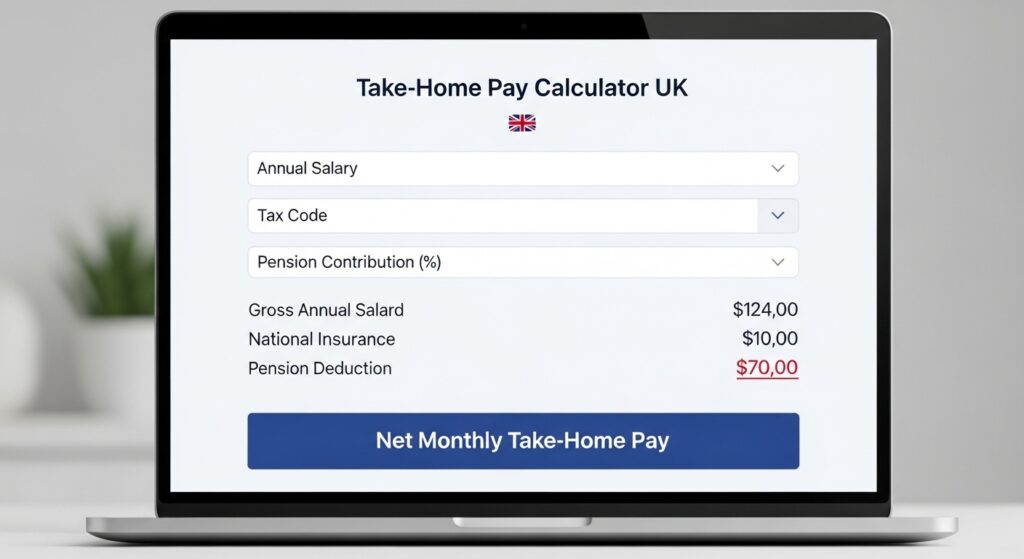
- Identify your gross annual salary
- Subtract personal allowance (tax-free portion)
- Apply tax rates to remaining income
- Deduct National Insurance contributions
- Subtract pension contributions
- Deduct student loan repayments (if applicable)
- Divide final amount by 12 for monthly take-home
Conclusion
A salary offer is only as valuable as what you actually take home.
Understanding how to convert gross salary into net pay gives you control. It allows you to:
- Make smarter career decisions
- Avoid financial surprises
- Negotiate with confidence
In a competitive job market like the UK, clarity is leverage.
If you want to position yourself for better opportunities, higher earnings, and smarter career moves, you need more than job applications; you need strategy.
Work with Sea-Faj Consults to align your skills, salary expectations and career goals effectively.
FAQs
1. How accurate are take-home pay calculators in the UK?
They are highly accurate if you input correct details such as salary, pension contributions, and loan status.
2. Does pension contribution significantly reduce take-home pay?
Yes, but it’s a long-term benefit. It slightly lowers monthly income while building future financial security.
3. Can I negotiate salary based on take-home pay?
Indirectly, yes. Understanding your net pay helps you negotiate a gross salary that meets your financial needs.
4. Do international job seekers pay the same taxes in the UK?
Generally, yes, if classified as UK tax residents. However, specific situations may vary.
5. What is a good take-home salary in the UK?
It depends on location, lifestyle, and responsibilities. Always evaluate salary against cost of living and personal goals.